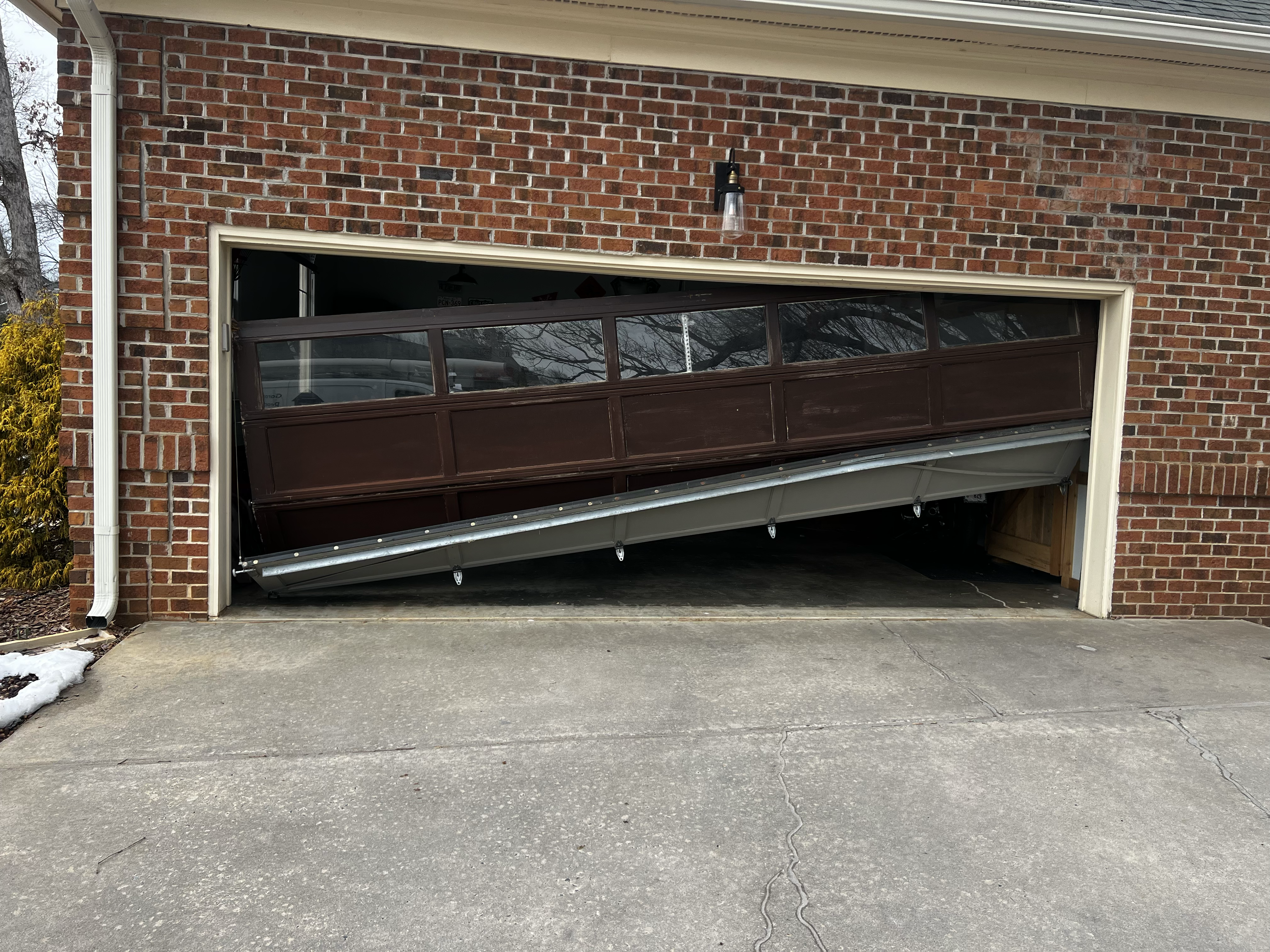
An off-track garage door is a dropped-load event that has not finished happening yet. The rollers left the rail, the cables may have jumped their drums, and a door that weighs as much as a rider mower is now hanging on whatever hardware happens to still be holding. Treat it like a car on a failing jack, not a drawer off its rail. In this article we explain what actually happened inside the system, what the repair costs on current national data, and why every press of the opener button after the first bind moves you up the price ladder.
What “Off Track” Actually Means
The track never lifts your door. Springs and cables carry the weight; the track only steers it. Each section of a sectional door rides on rollers that sit inside a curved steel channel, and the whole load hangs from two lift cables wound onto drums at the top of the door. When a roller pops out of that channel, the door loses its steering on one side while the cables keep pulling. The door racks, one side climbs while the other drags, and the cable on the low side goes slack.
That slack cable is the detail most homeowners miss. A slack cable can jump its drum and bird-nest around the shaft, and once it does, the door’s weight has nowhere to go. The crooked door in your garage is not misaligned. It is partially dropped, and the only question is whether the rest of the drop happens slowly under a technician’s control or suddenly on its own.
The First Five Minutes: Stop Everything
Take your thumb off the opener button and leave it off. If the door is moving, press the wall button once to stop it, then keep children, pets, and the car away from the opening. Unplug the opener so a remote in someone’s pocket cannot cycle it while you are standing under the door.
Here is where we break with most of the advice you will find on page one of Google: do not pull the red emergency release cord on a door that is open and off its track. The release cord disconnects the door from the opener trolley, and on a healthy, balanced door, that is exactly what you want when the power goes out. We wrote a full guide on how to open garage door manually for that situation. On an off-track door, the opener trolley may be the only thing preventing a free fall. Pull the cord and you hand the door’s full weight to cables that may already be off their drums.
Leave the door exactly where it stopped. A door frozen mid-travel looks wrong and feels urgent, and it is still safer crooked and still than moving.
Why Forcing It Turns a $200 Visit Into a $1,200 Problem
A jammed door stops for a mechanical reason, and the opener cannot tell. It only knows to pull. Force a racked door and three things happen in order: the stuck roller gouges or bends the track, the twisting load transfers into the panel skins and hinge stiles, and the slack cable wraps somewhere it should not. Each stage adds a line item. Bent sections rarely bend back; once a panel creases, you are pricing garage panel replacement instead of a track reset.
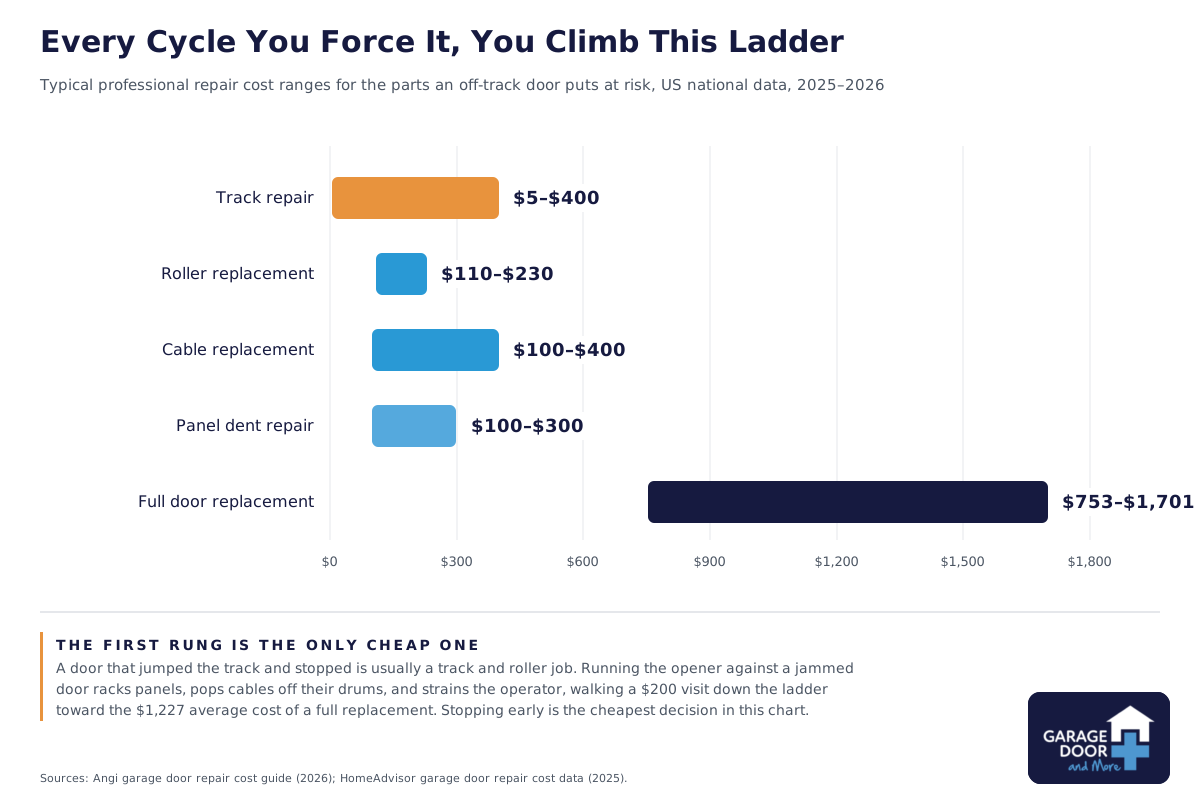
The current numbers make the point better than we can. On Angi’s 2026 cost data, the average garage door repair runs $265, track parts cost $40 to $120, and roller replacement lands between $110 and $230 with labor. HomeAdvisor’s 2025 data puts track work anywhere from $5 for a single bracket to $400 for a full track replacement, cable work at $100 to $400, and panel dent repair at $100 to $300. A full door replacement averages $1,227 in Angi’s 2026 replacement cost data, with a typical range of $753 to $1,701. The gap between the top and bottom of that ladder is the cost of continuing to press the button.
“The most expensive part in your garage is the thumb that keeps pressing the opener button. The door already told you it’s hurt. Every cycle after that, you’re paying us to fix something new.”
The Technicians at Garage Door and More
What Knocked It Off in the First Place
Doors almost never jump the track out of nowhere. In our trucks, the same four causes account for nearly every off-track call we run in the Charlotte area.
Worn rollers. Builder-grade rollers use small steel wheels on short stems, and they wear ovals into themselves over years of cycles. A worn roller wobbles in the channel until one day it wobbles out. The warning sign comes first as sound: noisy garage door rollers grind and squeal for months before they fail. Full garage door roller replacement is one of the cheapest jobs on the whole door, which makes it the cheapest off-track prevention there is.
A failing cable. A frayed garage door cable announces itself weeks in advance, shedding broken strands you can see near the bottom bracket. When it lets go, one side of the door drops, and the rollers on that side get levered out of the channel. Garage door cable replacement is a technician’s job, full stop, because those cables carry the door’s weight under spring tension.
An impact. A car bumper at two miles an hour, a trash can, a basketball hoop base. Vertical track is light-gauge steel, and a quarter-inch dent is enough to stop a roller cold.
Loose or aging hardware. Track brackets vibrate loose over thousands of cycles, and the lag screws holding them to the jamb work out of wood that has been expanding and contracting through decades of Carolina summers. This cause is growing for a simple reason: the houses are getting older. Per the NAHB’s 2026 analysis of Census American Community Survey data, the median owner-occupied US home was 42 years old in 2024, up from 31 in 2005, and homes at least 45 years old now make up 47% of the stock, up from 39% a decade earlier. Homebuilding never recovered its pre-2008 volume, so the hardware hanging in American garages keeps aging faster than new construction dilutes it. We project the median reaches roughly 44 years by 2028, which means more doors running on original rollers, original brackets, and original tracks every year.
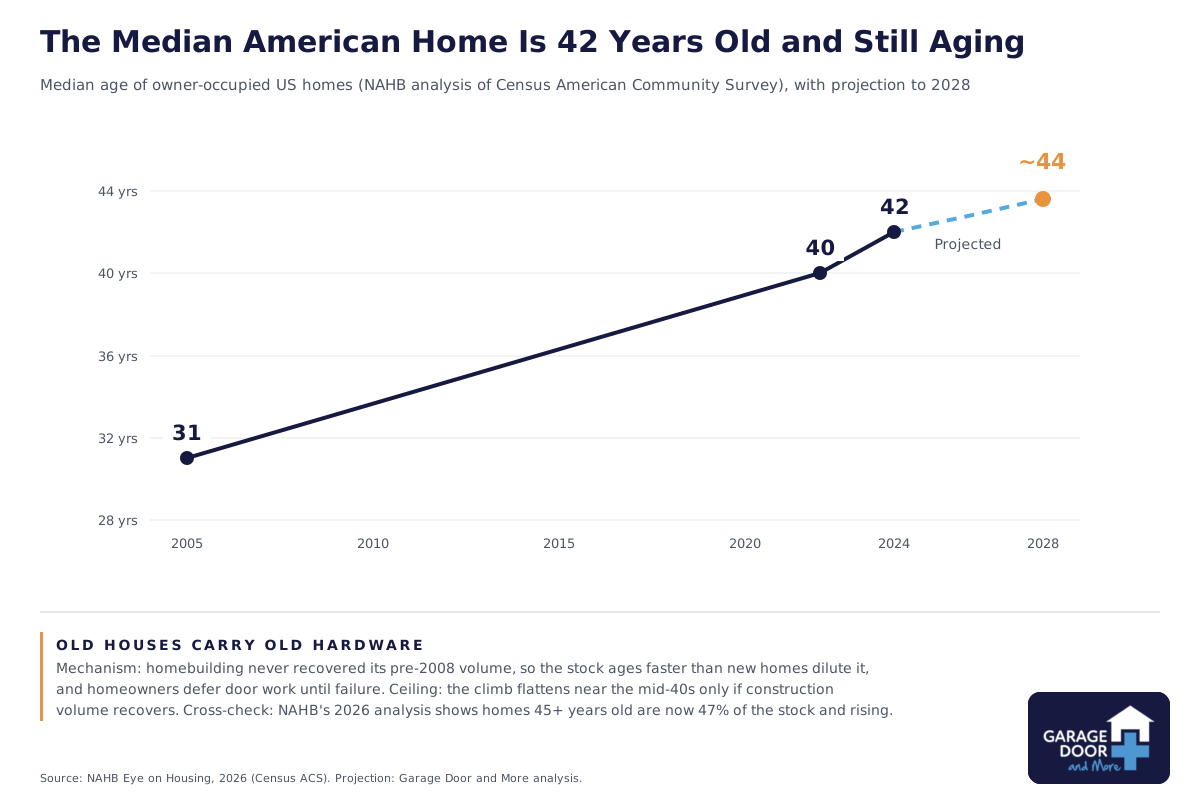
Projection: Garage Door and More analysis based on the post-2008 construction shortfall and homeowner deferral of replacement, assuming the climb flattens near the mid-40s only if new-home construction volume recovers, cross-checked against NAHB’s 2026 finding that homes 45+ years old have risen to 47% of the owner-occupied stock.
The DIY Line: Where We Draw It and Why
We will explain every part of this repair, and we still tell homeowners not to attempt it. That is not gatekeeping; it is arithmetic about stored energy. Putting a door back on its track means lifting sections by hand, working beside cables under spring tension, and in most real off-track calls, rewinding cable onto drums, which cannot be done without controlling the torsion system. The line we draw for every customer is the same: anything you can reach without touching a loaded part, you may do. Anything connected to springs, cables, drums, or bottom brackets, you may not.
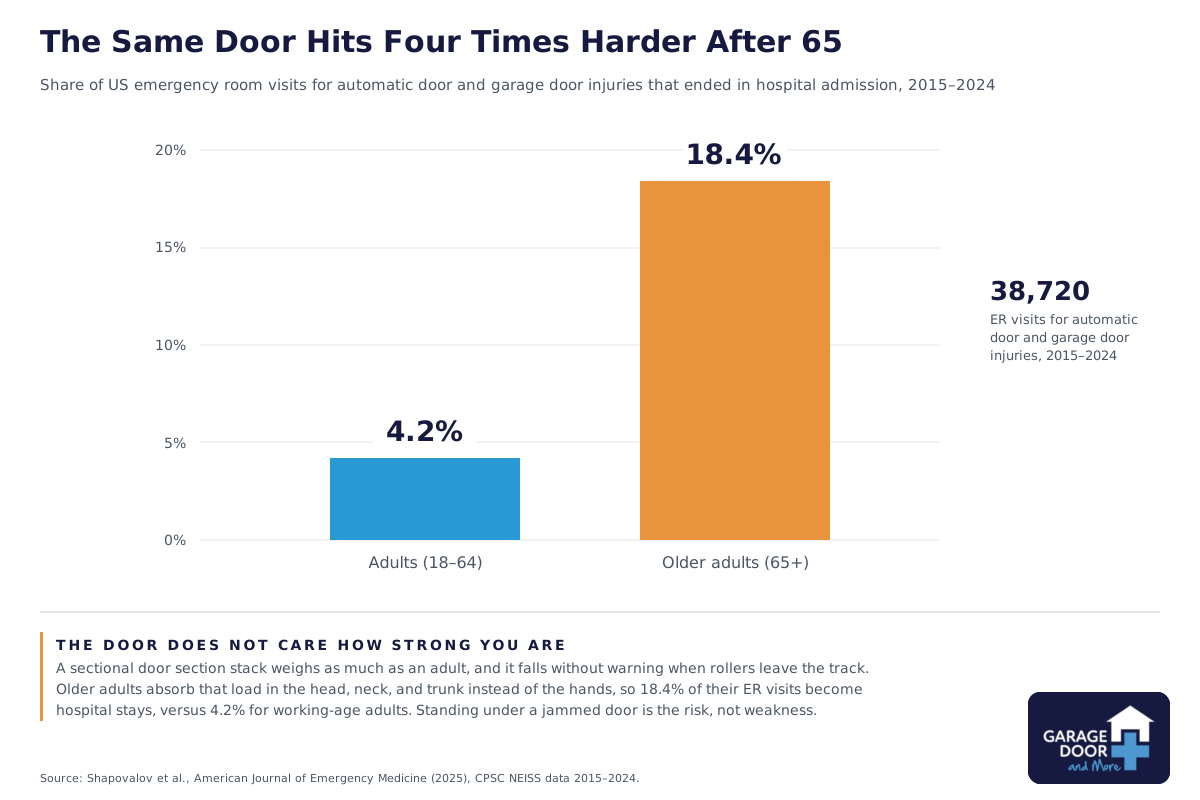
The injury data behind that line is not hypothetical. A 2025 study in the American Journal of Emergency Medicine, built on the government’s NEISS injury surveillance data, counted an estimated 38,720 US emergency room visits for automatic door and garage door injuries from 2015 through 2024, with the trend climbing again in 2023 and 2024. The severity split is what should get your attention: 18.4% of ER visits by adults 65 and older ended in hospital admission, against 4.2% for working-age adults, and older adults faced 3.18 times the odds of a severe injury because they absorb the load in the head, neck, and trunk rather than the hands. A 2023 Massachusetts Eye and Ear case series documented seven patients who lost part or all of their vision in one eye when hardware let go during DIY garage door repairs. Springs and cables do not give warnings; they give releases.
“I’ll walk any homeowner through how their door works, every part of it. I won’t hand them a job where the steel is under load. A track looks harmless right up until you remember what it’s steering.”
The Technicians at Garage Door and More
What a Professional Off-Track Repair Looks Like
A competent off-track visit is mostly inspection, because resetting the rollers without finding what ejected them guarantees a repeat call. Our technicians secure the door first, then work through the system in order: track condition and plumb, roller wear, cable condition on both drums, spring balance, and only then the reset. A door that gets reseated, rebalanced, and force-tested should run quieter than it did the week before it failed. If yours went crooked this morning, we handle garage door off track repair across the Charlotte metro, and because a stuck door can trap a car or leave a house standing open, we treat it as same day garage door repair work, not a next-week appointment. That is a service standard, not a scare tactic; nothing about an off-track door requires panic, only stillness until a trained person arrives.
Expect an honest quote to itemize the reset, any parts, and the balance check separately. If you want to sanity-check a number before anyone rolls a truck, our breakdown of the price to repair garage door problems in Charlotte covers what fair looks like line by line.
When the Off-Track Door Is the Symptom, Not the Disease
Our repair-first rule still runs this call: if your door is under 15 years old and the panels are sound, fix the track and rollers and keep your money. A $200 to $400 reset that buys years of service beats a $1,200-plus door every time, and we quote it that way even when the bigger sale is sitting right there.
The math flips in two situations. First, when forcing the door already creased multiple panels, because section costs stack up fast against the price of a new door. Second, when the door is old enough that the track failure is just the first domino, with worn rollers, tired springs, and rusted fixtures right behind it. Our guide to the repair or replace garage door decision walks through the full test.
If you land on replacement, the resale data is unusually strong right now. Zonda’s 2025 Cost vs. Value report puts garage door replacement first among all 28 projects tracked, recouping 267.7% of its cost: a $4,672 average job adding $12,507 in estimated resale value. Keep two things in mind about that number. The resale values come from surveys of real estate professionals, so they are expert estimates, not measured sale prices. And the figure is a spike, not a baseline: the same report series showed 93.8% in 2021, 93.3% in 2022, 102.7% in 2023, and 193.9% in 2024. We read the 2024 and 2025 numbers as a premium paid by a low-inventory, high-rate market that rewards move-in-ready exteriors, and we project it reverts toward the 100% to 150% range by 2028 as inventory normalizes. Zonda’s own 2025 commentary ties the spike to a demand shift it compares to 2012, which supports reading it as temporary. So replace because the door has earned retirement, and schedule the garage door replacement knowing the resale math currently works in your favor, not because a record percentage will still be there in three years.
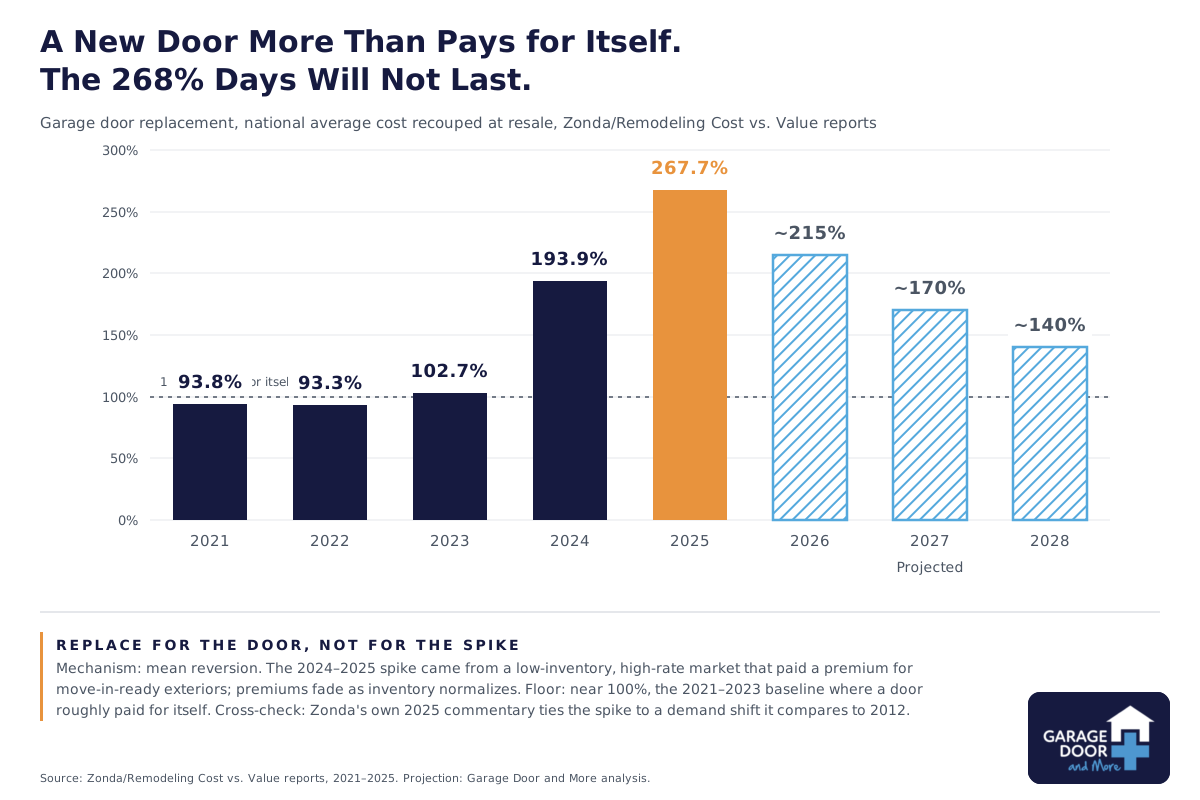
Projection: Garage Door and More analysis based on mean reversion of the 2024–2025 market premium, assuming a floor near 100% (the 2021–2023 baseline where a new door roughly paid for itself), cross-checked against Zonda’s 2025 report commentary attributing the spike to a housing demand shift comparable to 2012.
Keeping It On the Track Next Time
Most off-track doors gave weeks of warning, and all of it was audible. Grinding, popping at the same spot in travel, a door that shudders on the way down: each one is a roller or a cable asking for attention while the fix is still cheap. Twice a year, with the door closed and the opener unplugged, look at what you can see from the floor. Snug the visible track-bracket bolts, wipe grit out of the channel, put garage-door lubricant on the roller stems and hinges, and look for broken strands at the bottom of each cable. Touch nothing that is under tension.
The rest belongs to a professional inspection, which is the one purchase in this article that prevents every other purchase in this article. An annual garage door tune-up catches oval rollers, loosening brackets, and fraying cables on a schedule you choose, instead of the 7 am schedule the door chooses.
A door off its track is not an emergency you have to solve with your hands. It is an emergency you solve by stopping. Leave it where it sits, keep everyone out from under it, and let a technician bring it down the safe way. The door only gets one chance to fall; do not be the reason it takes it.