
Key takeaways
- DASMA, the garage door manufacturers’ association, says spring systems are dangerous and should be repaired only by trained professionals.
- Professional torsion spring replacement in Charlotte runs $175 to $325 for both springs including labor, against $50 to $100 for a pair of springs bought online.
- A slipped winding bar is the most common cause of serious DIY spring injuries, because it hands the full spring tension to whoever is holding it.
- Extension springs carry less tension than torsion springs but are still unsafe to replace without a properly threaded safety cable.
- Homeowners can safely lubricate springs, inspect hardware monthly and run a balance test; adjusting or replacing springs is a job for a technician.
Garage door spring repair is one job you should never do yourself, because a spring holds enough stored energy to break bones when it releases by accident. Online tutorials make torsion spring replacement look manageable: the tools seem simple, the steps look straightforward, and the savings look real. What the videos rarely show is what happens when something goes wrong. Garage Door and More is direct with Charlotte homeowners about this: spring repair is not a project where the savings are worth the risk, and the company has seen the results when it goes wrong.
What makes garage door springs so dangerous?
Garage door springs are dangerous because they store the energy needed to counterbalance a door that can weigh 150 to 400 pounds, and that energy releases all at once if anything slips. Torsion springs, the horizontal coil springs mounted on a shaft above the door, hold hundreds of pounds of torque even when the door is fully closed. Extension springs, which run along the horizontal tracks on each side, stretch under heavy load every time the door moves.
When a torsion spring lets go unexpectedly, from a tool slip, an incorrect winding or mishandled hardware, the release is violent and instant, and no one can react in time. The risk is real. DASMA’s garage door safety tips call springs “arguably the most important and most dangerous part of your door” and state that “spring systems are dangerous and should be repaired only by trained professionals.” Spring injuries tend to be serious: broken bones, deep cuts and worse.
Garage Door and More hears from homeowners or their family members a few times a year after a DIY spring attempt has gone wrong. Sometimes a winding bar slipped. Sometimes a spring released during removal. The injuries are not minor, and this is one of the few times the company will tell you plainly: please don’t try this yourself.
What tools does torsion spring replacement require?
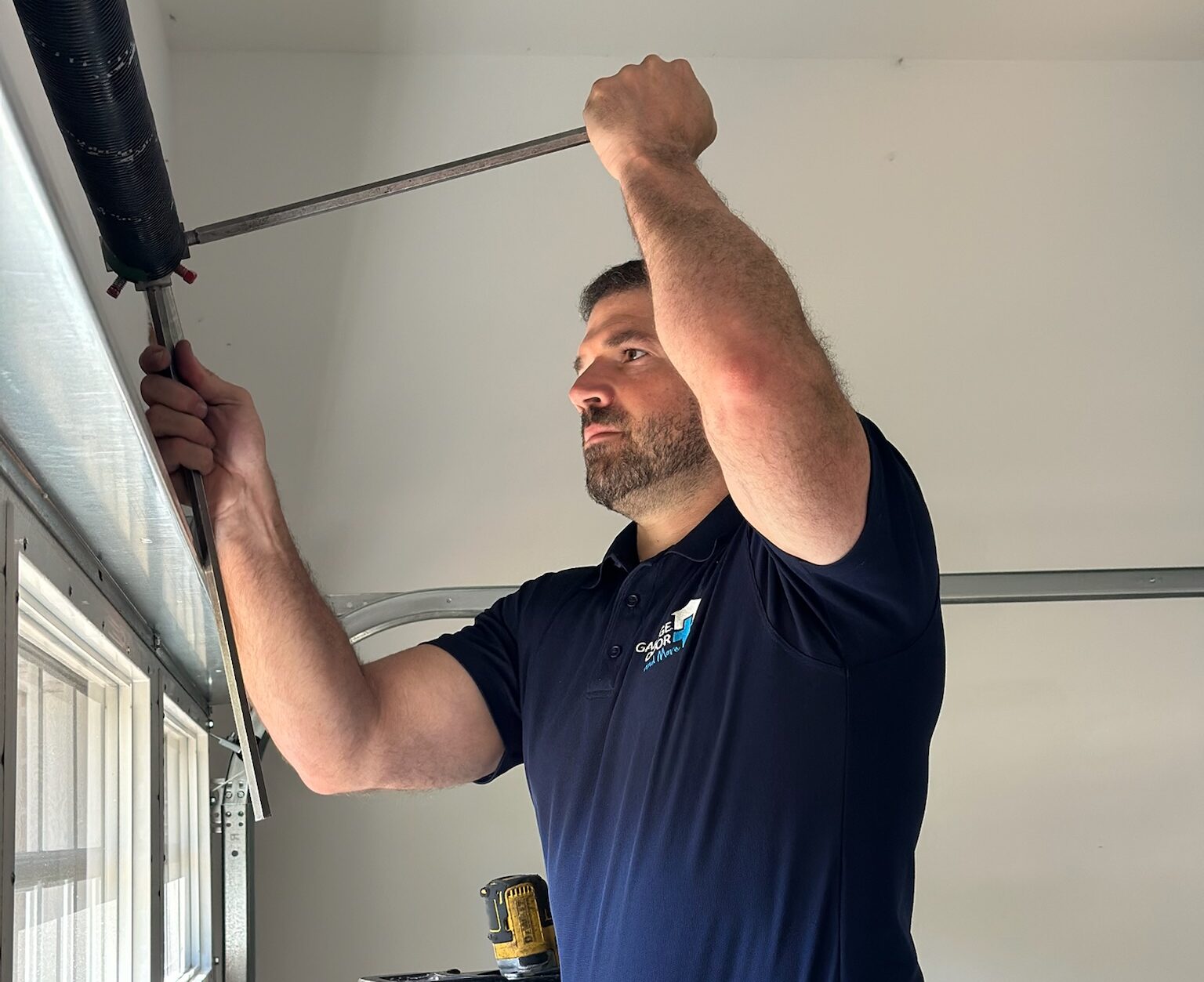
Torsion spring replacement requires winding bars, which are steel bars sized to fit the winding cone at the end of the spring so a technician can add or remove tension in controlled steps. Using the wrong size, substituting a screwdriver, or losing your grip at any point puts the full spring tension into the hands of whoever is holding the bar.
Winding means applying heavy force in quarter-turn increments while standing to the side of the spring, not in front of it, because a slip throws the winding bar forward like a projectile. Professional technicians take that position by habit. Someone learning from a video doesn’t have the muscle memory or awareness that comes from doing the work over and over.
Beyond winding bars, a proper spring replacement needs a torque wrench to set hardware to specification, a spring tension gauge, and the correct tension setting for that door’s weight. An incorrectly tensioned spring wears out faster and also puts uneven load on the opener, the cables and the drums on every cycle after that.
Why isn’t watching a video enough preparation?
Watching a video isn’t enough preparation because tutorials are filmed by experienced technicians under controlled conditions, usually on doors in good shape with nothing complicated going on. They don’t show a worn cable drum, corroded shaft hardware, stripped set screws on the winding cone, or a door that’s slightly off balance in a way that changes the tension calculation. Each of those situations is common on doors that need new springs, and each calls for on-the-spot judgment that only comes from experience.
These are the specific ways DIY spring attempts go wrong:
- The spring is the wrong size. Springs are matched to the door’s weight and drum size, and the wrong spring leaves the door over- or under-tensioned, so the opener struggles, cables and drums wear faster, and the unbalanced door can drop without warning.
- A winding bar slips off the cone during tensioning and releases violently. This is the most common cause of serious DIY spring injuries.
- The door isn’t secured first. A technician clamps or secures the door before removing spring tension, because an unsecured door on a broken spring can drop suddenly when the second spring’s tension changes.
- Cable and drum wear gets missed. Springs and cables wear together, so a technician replacing springs also checks cables, drums and bearing plates, while a DIYer focused on the spring often misses the worn part that fails weeks later.
- Set screws are torqued wrong. Under-torqued set screws let the spring slip on the shaft during operation, and over-torqued screws can crack the winding cone. Either one is dangerous.
Does DIY spring replacement really save money?
DIY spring replacement saves much less money than it seems to. A professional torsion spring replacement in Charlotte runs $175 to $325 for both springs, including labor. A pair of springs bought online or at a hardware store costs $50 to $100, so the apparent savings look like $125 to $225.
That math leaves out several real costs. Here are the hidden costs in a DIY spring replacement:
| Cost Factor | DIY | Professional |
|---|---|---|
| Spring parts | $50 – $100 (often wrong size first attempt) | Included in service price |
| Winding bars (required) | $25 – $50 | Not applicable |
| Risk of incorrect spring spec | Second purchase if wrong size ordered | Technician measures and brings correct spring |
| Secondary damage (cables, drums) | Often missed, causes follow-up failure | Inspected and flagged during service |
| Injury risk | Significant; potential ER visit | None for homeowner |
| Total professional service | Not applicable | $175 – $325 for both springs |
Once you add the cost of winding bars, the chance of ordering the wrong spring, and the real likelihood of missing wear a technician would catch, the savings shrink to a gap that doesn’t justify the injury risk.
Garage Door and More’s repair calls after a DIY attempt that went sideways always cost more than the original spring replacement would have. Sometimes a cable came off because the door wasn’t properly secured. Sometimes a drum cracked because the spring tension was set wrong. The company has seen that pattern often enough to know it is real.
What about extension springs: are those safer to DIY?
Extension springs are not safe to DIY either, even though they carry less tension than torsion springs. The way they fail is different. A broken extension spring can thrash violently if a safety cable isn’t threaded through it, and badly installed safety cables are a common DIY mistake. DASMA notes that extension springs are under high tension when the door is down and that “a safety cable can keep that broken spring contained.” Without a properly routed safety cable, a released spring can fly several feet with enough force to cause serious injury or damage.
Extension spring systems also need matched tension on both sides of the door. Installing one new spring without replacing the other, or using springs with mismatched tension ratings, leaves the door unbalanced, so it tracks unevenly and puts uneven load on the opener and hardware. For a full comparison of the two spring systems and what replacing each involves, see the guide to torsion vs. extension springs.
What legitimate maintenance can homeowners handle?
Homeowners can handle lubrication, monthly visual inspections, a balance test and tightening loose track or hinge bolts. Spring replacement falls squarely on the professional side of the line, but there are things you can and should do yourself between service visits:
- Spray white lithium grease or silicone on the spring coils, hinges and rollers to extend their life. Lubricating a spring is not the same as adjusting or replacing it.
- Look over the door once a month for rust, fraying cables or cracked rollers, so you call a professional before a failure instead of after.
- Run a balance test: disconnect the opener and lift the door by hand to about waist height. A properly tensioned door stays put (DASMA’s opener safety guide says a balanced door stays partly open 3 to 4 feet above the floor), and a door that drops or shoots up needs a technician.
- Check track brackets and hinges for loose bolts. Tightening loose hardware is fine for a homeowner; adjusting anything that holds spring tension is not.
The post on how to maintain your garage door draws a clear line between homeowner maintenance and professional repair for every part of the system. For spring work beyond lubrication, call a professional.
Who can replace a broken garage door spring safely in Charlotte?
Garage Door and More technicians replace broken garage door springs safely across Charlotte, and most replacements take under 90 minutes. Spring replacement is routine work for a trained technician and a serious safety situation for anyone without the training and tools. Garage Door and More stocks the correct spring sizes for standard residential doors in the Charlotte area.
If your spring is broken or seems to be losing tension, schedule a service appointment or call (980) 263-0092. Garage Door and More serves Charlotte and nearby towns such as Matthews, Mint Hill and Indian Trail, and can handle most broken spring repairs the same day you call.