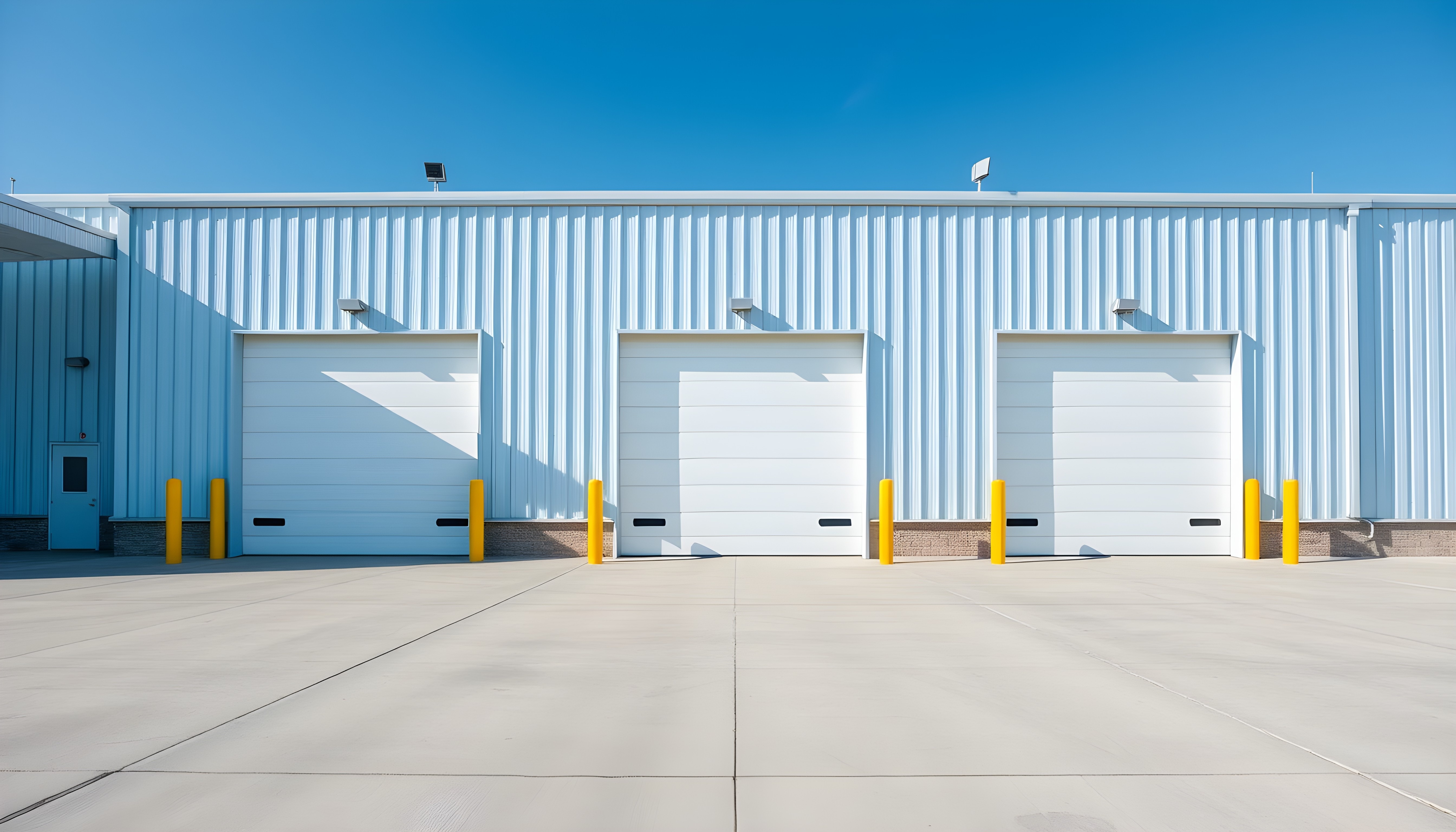
Charlotte’s industrial sector continues expanding with new warehouse facilities and distribution centers opening throughout the region. These operations depend on commercial garage door installation systems that handle high-volume daily use while maintaining security and environmental control. Selecting the right door configuration for your warehouse involves balancing operational needs, budget constraints, and long-term durability in ways that differ significantly from residential applications.
What Door Types Best Suit Warehouse Loading Operations?
Loading dock operations demand specific door configurations that residential or light commercial installations can’t adequately provide. The volume of daily cycles, size requirements, and speed needs dictate which door types perform reliably in warehouse settings.
Sectional overhead doors represent the most common choice for distribution centers. These doors consist of horizontal panels connected by hinges, operating on vertical tracks mounted to the building structure. The sectional design allows doors to open vertically while taking up minimal space inside the facility. Standard warehouse sectional doors range from 10×10 feet for smaller facilities to 14×14 feet or larger for major distribution centers. The modular panel construction means damaged sections can be replaced individually without replacing the entire door.
Rolling steel doors work well for facilities requiring maximum security and minimal maintenance. These doors feature interlocking steel slats that coil around a drum above the opening when raised. The continuous curtain design provides excellent security since it has no individual panels that could be pried apart. Rolling doors operate smoothly even with frequent use, making them popular for high-traffic loading docks. The coiled storage design maximizes interior ceiling clearance, valuable in warehouses where every inch of vertical space counts for racking and storage.
Warehouse Door Type Performance Characteristics:
| Door Type | Typical Size Range | Daily Cycle Capacity | Opening Speed | Best Application |
|---|---|---|---|---|
| Sectional Overhead | 10×10 to 16×16 feet | 50-100 cycles | 8-12 inches/second | General warehouse loading |
| Rolling Steel | 8×8 to 20×20 feet | 75-150 cycles | 6-10 inches/second | High-security facilities |
| High-Speed Fabric | 8×8 to 14×14 feet | 200-500 cycles | 40-60 inches/second | Temperature-controlled warehouses |
| Vertical Lift | 12×12 to 24×24 feet | 30-75 cycles | 10-15 inches/second | Full-height loading docks |
High-speed fabric doors solve problems in temperature-controlled environments where standard doors can’t cycle fast enough. These doors feature flexible PVC or vinyl panels reinforced with transparent windows. The lightweight material allows opening speeds of 40-60 inches per second compared to 8-12 inches per second for conventional overhead doors. This rapid cycling minimizes temperature loss in refrigerated warehouses while accommodating high-traffic patterns. The self-repairing design means the door can withstand impacts from forklifts and other equipment, automatically realigning after minor collisions.
Key Features for Different Warehouse Operations:
- Food Distribution Centers: Require doors with NSF-certified materials, smooth surfaces that don’t trap contaminants, and rapid cycling to maintain cold chain integrity throughout loading operations.
- Manufacturing Facilities: Need doors that withstand harsh chemicals, resist corrosion from industrial processes, and provide adequate ventilation when partially opened for air circulation.
- E-commerce Fulfillment: Benefit from high-cycle-rated doors with automated controls, minimal maintenance requirements, and reliability that prevents costly operational interruptions.
- General Warehousing: Perform well with standard sectional or rolling doors offering balanced performance across security, durability, and cost considerations.
“Charlotte’s distribution centers face unique demands because the region serves as a major logistics hub for the Southeast. We install doors that handle 150-200 cycles daily while maintaining security and environmental control. The wrong door choice costs operations thousands in energy waste and downtime.” – The Team at Garage Door and More
How Do Climate Control Requirements Affect Door Selection?
Temperature-controlled warehouse operations require door systems designed to minimize energy loss while maintaining throughput efficiency. Charlotte’s climate creates specific challenges for facilities managing refrigerated or climate-controlled storage.
Insulation values become critical for refrigerated warehouses. Door insulation is measured in R-value, indicating thermal resistance. Standard commercial doors offer R-values of 6-8, adequate for non-climate-controlled spaces. Refrigerated facilities need doors with R-values of 12-18 to prevent temperature fluctuations and reduce energy consumption. Polyurethane foam insulation between steel skins provides superior thermal performance compared to polystyrene alternatives, particularly in extreme temperature differentials.
Air infiltration losses often exceed conduction losses through the door itself. Seals around the door perimeter, between panels, and at the bottom threshold prevent conditioned air from escaping. High-quality seal systems include brush seals on the sides, bulb seals between sections, and bottom weatherstripping that compresses against the floor. A properly sealed 12×12 foot door prevents 1,000-2,000 cubic feet per minute of air infiltration compared to poorly sealed alternatives. This translates to substantial energy savings, particularly in refrigerated applications where every degree costs money.
Energy Performance Factors for Climate-Controlled Warehouses:
| Temperature Range | Minimum R-Value | Max Acceptable Air Infiltration | Recommended Door Speed | Annual Energy Impact |
|---|---|---|---|---|
| Ambient (70-80°F) | 6-8 | 2,000 CFM | Standard (8-12 in/sec) | Baseline |
| Cool (40-50°F) | 10-12 | 1,000 CFM | High-speed (30-40 in/sec) | +25% vs. ambient |
| Refrigerated (32-40°F) | 14-16 | 500 CFM | High-speed (40-60 in/sec) | +60% vs. ambient |
| Frozen (-10 to 0°F) | 16-20 | 250 CFM | Ultra high-speed (60+ in/sec) | +120% vs. ambient |
Opening speed directly impacts energy efficiency in climate-controlled environments. A standard overhead door taking 15-20 seconds to cycle allows significant temperature transfer. High-speed doors completing the same cycle in 3-5 seconds reduce this infiltration by 70-80%. Over hundreds of daily cycles, this time difference saves thousands of dollars annually in refrigeration costs. The investment in high-speed doors typically pays back within 18-36 months through energy savings alone.
Air curtains and vestibule designs complement door selection for maximum efficiency. Air curtains create an invisible barrier of moving air across the door opening when the door is raised, reducing temperature transfer even during open periods. Vestibule configurations use two doors creating an airlock effect, so only one door opens at a time. These supplementary systems work with properly selected doors to create complete environmental control, particularly valuable for facilities maintaining multiple temperature zones.
Which Safety Features Are Required for High-Traffic Loading Docks?
Warehouse loading docks present unique safety challenges because forklifts, pedestrians, and delivery vehicles operate in close proximity to moving doors. Proper safety systems prevent accidents while maintaining operational efficiency.
Photo-eye sensors represent the baseline safety requirement for all motorized warehouse doors. These sensors project an infrared beam across the door opening at multiple heights. If an object or person breaks the beam while the door closes, the system immediately reverses direction. Modern installations use multiple sensor pairs at different heights to detect forklifts, pedestrians, and ground-level obstructions. Single-beam systems leave dangerous gaps in coverage that multi-beam configurations eliminate.
Presence detection systems go beyond basic obstruction sensing to prevent accidents before they occur. Motion sensors detect activity in the door’s travel path and prevent closing until the area clears. Pressure-sensitive edges along the door bottom stop movement immediately upon contact, protecting people and equipment from crush injuries. Loop detectors embedded in the floor sense vehicles approaching the door and trigger automatic opening, reducing collision risks from drivers focused on maneuvering rather than door operation.
Mandatory Safety Features for Commercial Warehouse Doors:
- Emergency Breakaway Systems: Allow high-speed doors to separate from their tracks when struck by forklifts, preventing structural damage and allowing rapid door reset without replacing the entire door assembly.
- Manual Release Mechanisms: Enable door operation during power failures or garage door opener malfunctions, preventing trapped personnel or blocked loading operations during emergencies.
- Visual Warning Systems: Include flashing lights and audible alarms that activate before door movement begins, alerting personnel and forklift operators of imminent door operation.
- Soft-Edge Technology: Uses pressure-sensitive edges or infrared light curtains along the door’s bottom and sides to detect contact with people or objects, immediately stopping movement to prevent injuries.
- Automatic Reversing: Meets UL 325 standards requiring doors to reverse within two seconds of encountering resistance, preventing entrapment or crushing accidents during operation.
Lighting integration improves safety while supporting operational visibility. LED lights mounted on the door header or integrated into the door itself illuminate the dock area during door operation. Color-coded status lights communicate door position and operational status to forklift operators from a distance. Green lights indicate safe passage, yellow signals door movement in progress, and red warns of malfunctions or restricted access. This visual communication system reduces accidents in noisy warehouse environments where audible warnings get lost.
“We’ve seen too many accidents at loading docks where basic safety features were skipped to save costs. A forklift hitting a door without breakaway panels causes $10,000-20,000 in damage and days of downtime. The safety features cost a fraction of that and prevent injuries that could shut down operations entirely.” – The Team at Garage Door and More
What Maintenance Schedules Keep Warehouse Doors Operating Reliably?
High-cycle warehouse doors require proactive maintenance programs that differ substantially from residential or light commercial schedules. Reactive maintenance creates costly downtime, while preventive programs maximize door lifespan and operational uptime.
Daily operator inspections catch developing problems before they cause failures. Warehouse personnel should verify doors open and close smoothly without unusual sounds, check photo-eye alignment by testing the safety reversal function, and look for visible damage to panels, seals, or hardware. These quick checks take 2-3 minutes per door but identify issues when repairs are simple and inexpensive. A loose roller detected during daily inspection costs $50-100 to replace, while the same roller falling out of its track during operation can cause $1,500-3,000 in damage.
Monthly professional service maintains optimal performance for high-cycle installations. Technicians lubricate all moving parts including hinges, rollers, bearings, and springs. They inspect and adjust track alignment, verify opener force settings, test all safety systems, and check hardware tightness. This comprehensive service takes 45-90 minutes per door depending on size and complexity. Monthly maintenance extends component life by 30-50% compared to annual service intervals.
Recommended Maintenance Intervals by Usage Level:
| Daily Cycle Count | Professional Service | Spring Replacement | Opener Overhaul | Track Realignment |
|---|---|---|---|---|
| Under 25 cycles | Quarterly | Every 5-7 years | Every 10 years | Every 3-5 years |
| 25-75 cycles | Monthly | Every 3-4 years | Every 5-7 years | Every 2-3 years |
| 75-150 cycles | Bi-weekly | Every 18-24 months | Every 3-4 years | Annually |
| Over 150 cycles | Weekly | Annually | Every 2-3 years | Semi-annually |
Component lifecycle planning prevents unexpected failures that disrupt warehouse operations. Garage door springs have predictable lifespans based on cycle counts. A spring rated for 50,000 cycles in a facility running 100 cycles daily will need replacement after approximately 500 days. Tracking cycle counts and scheduling preventive replacement before failure prevents emergency service calls and operational downtime. Many facilities maintain spare critical components on-site, allowing rapid repairs without waiting for parts delivery.
Seasonal adjustments account for Charlotte’s temperature variations affecting door operation. Spring and fall require recalibrating opener force settings because temperature changes affect spring tension and door weight. Summer humidity demands extra attention to weatherstripping and seals that can swell or deteriorate. Winter cold may require adjusting lubricants to cold-weather formulations. These seasonal service visits prevent weather-related operational issues that slow loading dock productivity.
How Do Loading Dock Configurations Impact Door Requirements?
The physical arrangement of your loading docks determines which door types and sizes work effectively. Understanding these relationships prevents expensive retrofitting after initial installation.
Truck bay spacing affects door width selection and clearance requirements. Standard loading docks feature bays on 12-foot centers, accommodating 10-foot-wide doors with 2 feet of structural support between openings. Tighter 10-foot spacing requires narrower doors or cantilevered track systems that minimize the support column footprint. Wider spacing allows larger doors or dual-door configurations serving oversized delivery vehicles. The spacing decision made during facility design has permanent implications for door options and operational efficiency.
Dock leveler integration requires coordinating door installation with leveling equipment. The door must clear the dock leveler platform in all positions, including when the leveler extends to service trucks at different heights. Vertical-lifting doors work well with pit-style levelers because the door travels straight up, providing maximum clearance. Sectional doors require adequate headroom to accommodate the curved track transition from vertical to horizontal. Edge-of-dock levelers need minimal coordination but offer less versatility for varying truck heights.
Loading Dock Design Elements Affecting Door Selection:
- Approach Angle: Straight-in approaches allow standard door configurations, while angled approaches may require wider doors or offset installation to accommodate truck positioning and prevent trailer contact with door frames.
- Canopy Design: Weather protection canopies affect door mounting location and may require extended jamb designs or special flashing to prevent water infiltration around the door perimeter during rain.
- Dock Shelter Configuration: Inflatable or mechanical dock shelters seal against trailer sides, requiring doors that fully retract into the building without interfering with shelter operation or creating pinch points.
- Vehicle Restraint Systems: Trailer restraints that engage the rear impact guard may require door sensors that prevent closing while a truck is locked to the dock, integrating safety across multiple systems.
Interior ceiling clearance limits door track configurations and affects which door types fit your facility. Standard sectional doors need 18-24 inches of clearance above the opening for horizontal track mounting. Low-headroom track systems reduce this to 10-12 inches but cost 30-40% more than standard configurations. Vertical-lift doors require clearance equal to the full door height plus 24-36 inches for counterweight systems. Facilities with limited headroom often choose rolling doors because the coiled storage requires only 12-18 inches of clearance regardless of door size.
Exterior site constraints affect door operation and longevity. Loading docks facing south receive direct sun exposure that heats door panels and accelerates weatherstripping deterioration. North-facing docks in Charlotte experience minimal direct sunlight but collect moisture from reduced evaporation. Wind exposure varies by building orientation, with doors facing prevailing winds requiring stronger construction and more powerful operators. These site-specific factors influence door material selection, insulation requirements, and operator sizing.
“Every loading dock has unique requirements based on the facility’s location, building design, and operational needs. We’ve worked with Charlotte warehouses where standard door configurations simply won’t work because of ceiling height, approach angles, or truck types. Custom solutions cost more upfront but prevent operational headaches that last the facility’s entire life.” – The Team at Garage Door and More
Which Automation Options Improve Warehouse Efficiency?
Automated door controls reduce labor costs, improve throughput, and create consistent operational patterns that manual operation can’t match. The right automation level depends on your facility’s volume and operational complexity.
Radio frequency (RF) remote controls provide the simplest automation level. Forklift operators carry handheld transmitters that trigger door opening from 50-100 feet away, allowing the door to fully open before the forklift arrives. This eliminates wait time and prevents operators from leaving their vehicles to activate wall-mounted switches. Multi-frequency systems allow programming individual doors to specific remotes, preventing unauthorized access to restricted areas. Battery-powered remotes last 1-2 years under normal use before requiring replacement.
Motion sensor activation removes the need for operator interaction entirely. Sensors detect approaching vehicles or forklifts and automatically open the door, closing after a programmed delay once the area clears. Adjustable sensitivity settings prevent false activations from distant motion while reliably detecting intended traffic. Timer controls customize the open duration based on typical loading operations, balancing energy efficiency with operational convenience. More advanced systems integrate with warehouse management software to coordinate door operation with scheduled shipments.
Automation Technology Comparison for Warehouse Applications:
| Automation Type | Installation Cost | Operating Cost/Year | Cycle Speed | Best For |
|---|---|---|---|---|
| Manual (pull chain) | $0 | $0 | 20-40 seconds | Low-traffic bays |
| RF Remote | $300-600 | $50-100 | 12-20 seconds | Moderate traffic |
| Motion Sensor | $800-1,500 | $100-200 | 10-15 seconds | High-traffic bays |
| Loop Detector | $1,200-2,000 | $150-250 | 8-12 seconds | Mixed vehicle types |
| Integrated WMS | $2,500-5,000 | $300-500 | 6-10 seconds | Automated facilities |
Traffic light systems coordinate door operation with dock occupancy status. Red lights indicate the dock is occupied and the door should remain closed, yellow signals transition periods, and green shows availability for the next vehicle. These systems prevent multiple trucks from attempting to occupy the same dock simultaneously. Integration with vehicle restraint systems and dock levelers creates complete dock management, improving safety while increasing throughput. The visual communication works across language barriers in facilities with diverse workforces.
Predictive automation uses historical data to anticipate door operation needs. Systems learn typical traffic patterns and adjust door responsiveness during peak versus off-peak periods. Machine learning algorithms reduce energy waste by minimizing unnecessary door cycling while maintaining rapid response when needed. These advanced systems cost significantly more than standard automation but provide measurable efficiency gains in large facilities with consistent operational patterns. The technology particularly benefits facilities running multiple shifts with varying traffic volumes throughout the day.
What Security Considerations Apply to Warehouse Door Selection?
Warehouse security demands balance between access control and operational efficiency. The right security approach protects inventory while allowing rapid authorized access during business hours.
Locking mechanisms range from simple slide bolts to sophisticated electronic access control. Manual slide bolts cost little but require personnel to physically secure each door, creating delays and security inconsistencies. Electric locks integrate with access control systems, automatically securing doors when closed and releasing when authorized users activate them. These systems log every access event, creating audit trails for security reviews. Fail-secure locks remain locked during power failures, while fail-safe versions unlock to prevent trapping people during emergencies. The choice depends on whether security or life safety takes priority.
Door material strength affects resistance to forced entry. Standard 24-gauge steel panels provide adequate security for general warehousing but can be compromised with common tools. Heavier 20-gauge steel increases break-in resistance significantly. Reinforced doors using 18-gauge steel or aluminum with internal bracing resist even determined forced entry attempts. High-security applications may specify doors with steel rod reinforcement in each panel or continuous steel backing. The material upgrade costs 40-60% more than standard construction but provides substantially better protection.
Security Feature Integration for Warehouse Protection:
- Impact-Resistant Construction: Doors rated for wind load resistance also resist forced entry attempts because the structural reinforcement prevents panel deformation under impact.
- Alarm Integration: Door sensors connect to facility alarm systems, triggering alerts when doors open during unauthorized hours or when forced entry attempts are detected.
- Video Surveillance Coordination: Camera positioning syncs with door operation, automatically recording all entry and exit events while providing visual verification of access authorization.
- Time-Based Access Control: Programmable systems automatically lock doors outside operating hours while allowing unrestricted access during business periods, eliminating manual lock/unlock procedures.
- Emergency Egress Compliance: Security measures must accommodate emergency exit requirements, typically through separate personnel doors or override systems that allow exit but trigger alarms.
Remote monitoring allows security personnel to oversee door status across multiple facilities from centralized locations. Web-based platforms display real-time door position, lock status, and alarm conditions. Mobile apps provide alerts when doors open unexpectedly or remain open beyond programmed durations. These systems reduce the security guard footprint needed while improving response times to security events. Integration with existing security infrastructure prevents the need for separate monitoring systems.
Anti-lift devices prevent doors from being forced upward when locked. Standard overhead doors can be pried up from the bottom even when electrically locked if they lack proper anti-lift hardware. Pin-style locks drop through the track when the door closes, physically preventing upward movement. These mechanical backups work even during power failures and resist tampering better than electronic-only security. Combined with electric locks, anti-lift devices create layered security that addresses multiple attack vectors.
How Do Local Building Codes Affect Warehouse Door Installation?
Charlotte and Mecklenburg County building codes establish minimum standards for commercial door installations. Understanding these requirements prevents expensive corrections after installation.
Wind load ratings represent a critical code requirement for exterior doors. Charlotte falls in a moderate wind zone requiring doors to withstand sustained winds of 90-110 mph depending on building height and exposure. Doors must be tested and labeled to verify compliance with these requirements. The wind rating affects door thickness, reinforcement, and mounting hardware specifications. Facilities near the airport or in elevated locations may face stricter requirements because of increased wind exposure.
Fire rating becomes necessary when warehouse doors separate different fire zones or provide access to fire-rated corridors. Fire-rated doors must resist fire spread for specified durations, typically 60-90 minutes for warehouse applications. These doors use special materials, construction techniques, and hardware that maintain integrity under fire exposure. Testing and certification from recognized laboratories verify compliance. Fire-rated doors cost 2-3 times more than standard doors but are mandatory when code requires them for life safety.
Charlotte-Area Code Requirements for Commercial Doors:
| Requirement Type | Standard | Verification Method | Typical Cost Impact |
|---|---|---|---|
| Wind Load Rating | 90-110 mph sustained | Label certification | +15-25% vs. non-rated |
| Fire Rating | 60-90 minutes | UL certification | +100-200% vs. standard |
| Safety Standards | UL 325 compliance | Operator certification | +10-15% vs. basic |
| Energy Code | R-8 minimum for climate-controlled | Manufacturer specification | +30-50% vs. uninsulated |
| ADA Compliance | Opening force under 5 lbs | Force gauge testing | +20-30% for low-force operators |
Energy code compliance affects door selection in climate-controlled facilities. The International Energy Conservation Code (IECC) adopted by Charlotte specifies minimum R-values for doors separating conditioned and unconditioned spaces. Refrigerated warehouses face stricter requirements than ambient-temperature facilities. The code also limits air infiltration rates, affecting seal specifications and construction quality. Meeting energy code requirements costs more upfront but creates long-term savings through reduced operating expenses.
Accessibility requirements apply to doors serving areas accessible to employees or the public. The Americans with Disabilities Act (ADA) limits the force required to open doors, typically 5 pounds or less for manual operation. This requires low-friction hardware, proper spring balancing, and often powered operators that reduce opening force to nearly zero. Emergency exit doors need panic hardware that operates with minimal force and clear signage meeting ADA visibility standards. These requirements add costs but are legally mandatory for most warehouse applications.
“We’ve seen warehouse projects delayed for months because door selections didn’t meet code requirements discovered during final inspection. Starting with code-compliant specifications prevents these issues. The Charlotte building department has gotten stricter about enforcement in recent years, particularly for energy code and wind load requirements.” – The Team at Garage Door and More
What Lifecycle Costs Should Warehouse Operators Budget For?
The purchase price represents only a fraction of total door ownership costs over a facility’s lifespan. Comprehensive lifecycle analysis reveals the true economic impact of door selection decisions.
Initial installation costs vary dramatically by door type and specification. A basic 12×12 sectional door with standard operator costs $3,500-5,000 installed. The same size in a high-speed model runs $12,000-18,000. Adding insulation, upgraded safety features, and automation increases costs further. While the price difference seems substantial, the lifecycle comparison tells a different story. The high-speed door cycling 200 times daily saves energy, reduces maintenance, and lasts longer than the standard door cycling the same number of times.
Energy consumption creates ongoing costs that accumulate over decades. An uninsulated door in a refrigerated warehouse loses $2,000-4,000 worth of cooling annually through conduction and infiltration. Upgrading to a high-R-value door with proper seals reduces this to $500-1,000 annually. Over a 20-year door life, the energy savings total $30,000-60,000, far exceeding the initial upgrade cost. High-speed doors compound these savings by reducing open time, cutting energy loss by an additional 60-70%.
20-Year Total Cost of Ownership Comparison:
| Door Type | Initial Cost | Energy Cost | Maintenance Cost | Replacement Cost | Total 20-Year Cost |
|---|---|---|---|---|---|
| Standard sectional (non-insulated) | $4,000 | $60,000 | $8,000 | $4,000 | $76,000 |
| Insulated sectional (R-16) | $6,500 | $20,000 | $6,000 | $6,500 | $39,000 |
| High-speed fabric (standard) | $15,000 | $8,000 | $12,000 | $0 | $35,000 |
| High-speed insulated | $22,000 | $6,000 | $10,000 | $0 | $38,000 |
Maintenance expenses depend on usage intensity and door quality. Budget $400-800 annually for doors cycling 50-100 times daily, $1,000-1,500 for 100-200 cycles, and $1,500-2,500 for operations exceeding 200 daily cycles. These figures assume preventive maintenance programs that catch problems early. Reactive maintenance following failures costs 2-3 times more because emergency service commands premium rates and collateral damage often accompanies major failures. A broken spring during business hours may damage the door, opener, and adjacent equipment while creating operational downtime costing thousands per hour.
Downtime costs often dwarf direct repair expenses. A failed door at a distribution center processing 500 shipments daily stops $50,000-100,000 worth of throughput per hour. Even a two-hour repair creates significant economic impact. This operational risk makes door reliability a critical selection factor, often justifying premium equipment that reduces failure probability. Facilities with multiple doors can absorb occasional downtime by shifting traffic, while single-door operations need maximum reliability regardless of cost.
Which Warranties and Service Agreements Protect Warehouse Investments?
Warranty coverage and service agreements determine who bears the cost when equipment fails. Understanding these protections helps you make informed decisions about door purchases and ongoing support.
Manufacturer warranties typically cover defects in materials and workmanship for 1-5 years depending on the door type and price point. Basic sectional doors may include 1-year parts warranties, while premium products offer 5-7 year coverage. Read warranty terms carefully because they often exclude wear items like springs, cables, and rollers. Labor coverage varies, with some manufacturers including installation labor for the first year while others provide parts-only coverage. Extended warranties available for purchase typically cost 10-15% of the door price and extend coverage to 10 years.
Service agreements provide scheduled maintenance and priority response to breakdowns. Monthly service plans for warehouse doors cost $150-400 per door depending on cycle count and door complexity. This covers all routine maintenance including lubrication, adjustments, and inspections. Most agreements include discounted repair rates, parts at cost, and priority scheduling for breakdowns. Facilities operating 24/7 benefit from service agreements offering after-hours support without emergency surcharges. The predictable monthly cost simplifies budgeting compared to unpredictable repair expenses.
Service Agreement Components to Evaluate:
- Response Time Guarantees: Specify maximum response times for service calls, typically 4-24 hours depending on agreement level, with penalties if the provider fails to meet commitments.
- Parts Inventory: Premium agreements may guarantee parts availability through dedicated stock at the service provider’s location, reducing downtime from parts ordering delays.
- Preventive Maintenance Frequency: Clear schedules defining monthly, quarterly, or custom service intervals based on your door usage patterns and manufacturer recommendations.
- Coverage Limitations: Understanding what’s included versus excluded prevents surprise costs, particularly regarding abuse damage, vandalism, or issues from improper use.
- Performance Metrics: Some agreements include uptime guarantees or performance standards with credits or adjustments when targets aren’t met.
Door performance monitoring through connected sensors provides early warning of developing problems. Smart door systems track cycle counts, opening times, and force measurements. Deviations from normal patterns trigger service alerts before failures occur. Cloud-based monitoring platforms allow facilities managers to track all doors across multiple buildings from a single dashboard. This predictive approach prevents unexpected failures while optimizing maintenance timing. The monitoring systems typically add $500-1,200 per door to initial costs but reduce long-term maintenance expenses through early problem detection.
Total cost of ownership calculations should include warranty value and service agreement expenses. A door with a comprehensive 5-year warranty and included labor costs $2,000 more than a similar door with a 1-year parts-only warranty. Over five years, the warranty difference provides $3,000-5,000 in value through covered repairs. Service agreements costing $3,000-6,000 annually prevent downtime worth tens of thousands of dollars. These protections become more valuable in facilities where door failures create substantial operational disruptions.
FAQs About Warehouse Garage Doors in Charlotte
What door size works best for standard warehouse loading docks?
Standard warehouse loading docks use 10×10 or 12×12 foot doors fitting bays on 12-foot centers. These sizes accommodate most delivery trucks while leaving structural support between bays. Oversized vehicle operations may need 14×14 or custom sizes. The door should provide 6-12 inches of clearance around the truck opening for safe maneuvering.
How often should high-cycle warehouse doors receive professional maintenance?
Doors cycling 75-150 times daily need professional service monthly to maintain reliability. Operations under 75 cycles can often extend to quarterly service. High-volume operations exceeding 150 daily cycles benefit from bi-weekly or weekly inspections. Tracking cycle counts helps determine optimal service intervals for your specific usage patterns.
Can existing warehouse doors be upgraded with high-speed operators?
Standard sectional doors rarely convert successfully to high-speed operation because the door weight and construction aren’t designed for rapid cycling. High-speed systems require lightweight doors with specific balance characteristics. Converting typically costs nearly as much as new high-speed door installation while providing inferior performance and reliability compared to purpose-built systems.
What insulation value is needed for refrigerated warehouse doors?
Refrigerated warehouses operating at 32-40°F need doors with R-values of 14-16 minimum. Frozen storage below 0°F requires R-18 or higher. Proper weatherstripping and high-speed operation matter as much as insulation because air infiltration causes more energy loss than conduction through properly insulated doors.
Do warehouse doors require permits for installation in Charlotte?
Commercial door installation typically requires building permits in Charlotte and Mecklenburg County. The permit process verifies compliance with building codes, wind load requirements, and fire safety standards. Professional installers handle permitting, inspections, and code compliance documentation. Operating without proper permits creates liability issues and complications during property sales or refinancing.
What’s the expected lifespan of warehouse loading dock doors?
Standard sectional doors cycling 50-75 times daily last 12-18 years with proper maintenance. High-cycle operations reduce this to 7-12 years. High-speed fabric doors designed for frequent cycling can exceed 20 years because they’re built for the demanding use. Harsh environments, poor maintenance, or abuse significantly reduce these lifespans.
How much does emergency warehouse door repair cost in Charlotte?
Emergency service typically adds $200-400 to standard repair costs for after-hours calls. The actual repair expense varies by damage severity, ranging from $300-800 for spring or cable replacement to $2,000-5,000 for major structural damage. Service agreements often waive or reduce emergency surcharges while providing priority response during critical failures.
Can warehouse doors integrate with existing building automation systems?
Modern warehouse doors connect to building management systems through standard protocols like BACnet or Modbus. Integration allows centralized monitoring, automated operation based on building schedules, and data collection for facility management. The interface hardware costs $800-2,000 per door but provides valuable operational insights and control capabilities for facility managers.
Garage Door and More specializes in commercial door solutions for Charlotte’s warehouse and distribution facilities. Our team understands the unique demands of high-volume loading operations and designs door systems that balance performance, efficiency, and reliability. We handle everything from initial specification and code compliance through installation, preventive maintenance, and rapid repair response. Contact us for professional guidance on warehouse door systems that will support your operations for years to come.