Self-storage facilities operate on a model where door reliability is directly tied to tenant satisfaction, revenue protection, and operational continuity. A unit door that sticks, won’t lock properly, or fails during a tenant’s access window creates immediate problems, and at scale those problems compound. At Garage Door and More, we work with storage facility operators across Charlotte on both new installations and replacements, and the requirements for this application are specific enough to warrant a dedicated conversation before any purchasing decisions are made.
What Makes Self-Storage Door Installations Different From Standard Commercial Work?
Self-storage facilities present a unique combination of requirements that distinguishes them from most other commercial door applications. Unlike a warehouse or service bay with a small number of large doors, a storage facility may have dozens to hundreds of individual unit doors cycling across multiple access hours each day. That volume of doors, each with its own hardware, lock point, and operating mechanism, requires a different approach to specification, installation sequencing, and ongoing service planning.
Tenants also interact with unit doors without staff supervision. The door needs to function correctly for someone who has never operated it before and may not be there to report a problem before the next tenant encounters it. Reliability and ease of operation aren’t just convenience features in this context; they’re directly tied to your facility’s reputation and tenant retention.
“Storage facility operators often underestimate how much door reliability affects tenant reviews and renewals. When a tenant can’t get their unit open, they’re not calling a facility manager to troubleshoot — they’re leaving a one-star review. The investment in quality doors and proper installation pays back in ways that don’t always show up directly on a maintenance cost spreadsheet.” — The Team at Garage Door and More
What Door Types Are Best for Self-Storage Units?
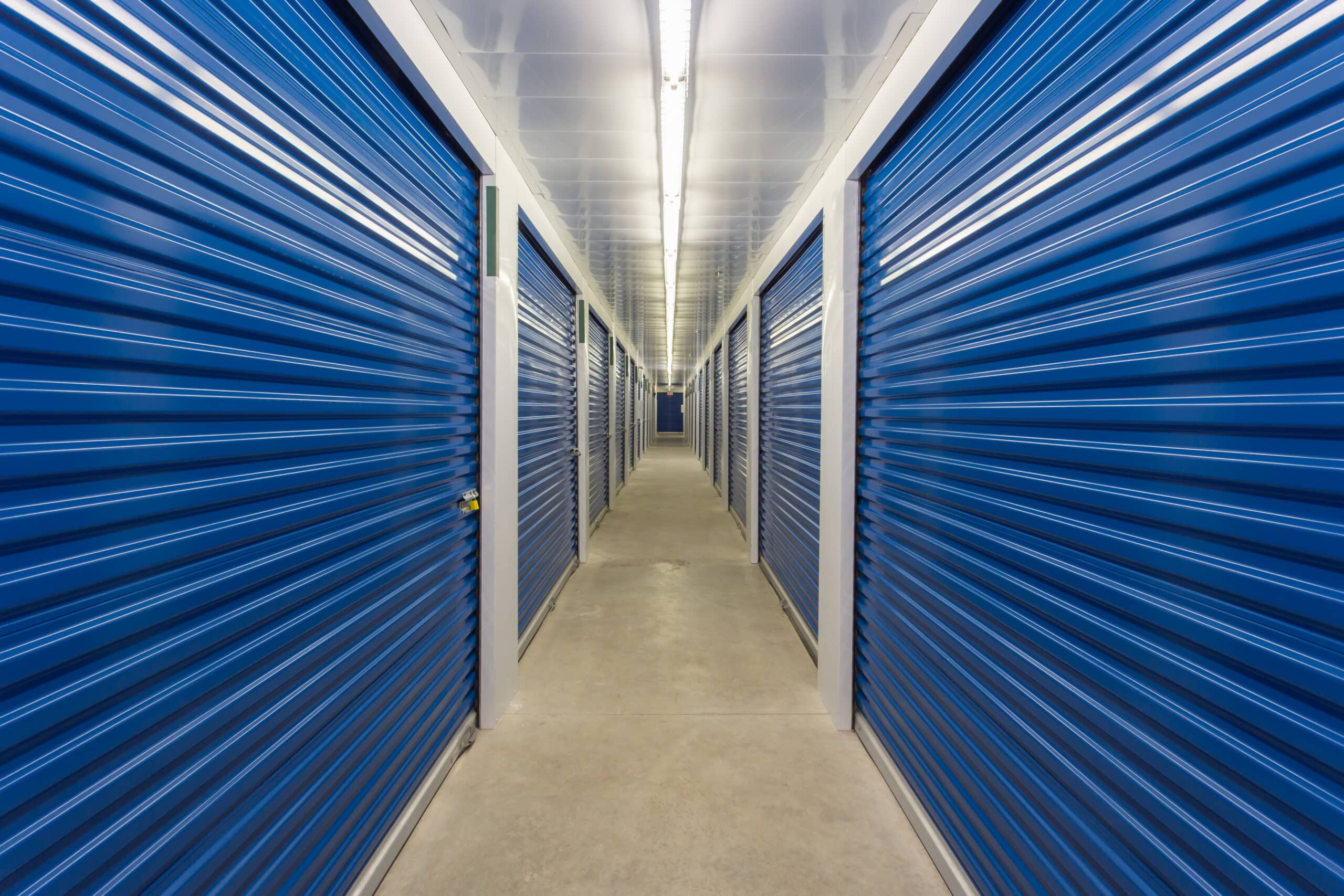
The standard for self-storage unit doors is the roll-up sheet door, also called a coiling door. These doors coil upward into a drum housing above the opening rather than swinging out or folding into sections. For storage applications, this design has several practical advantages over sectional doors.
Why roll-up sheet doors are the dominant choice for storage units:
- No overhead space required inside the unit: Roll-up doors coil above the opening in a compact drum, leaving the full interior ceiling height of the unit accessible. Sectional doors require horizontal track space inside the unit, which reduces usable storage height and can obstruct tall items near the door.
- Simpler locking mechanism: Roll-up doors use a straightforward hasp and padlock or built-in cylinder lock at the bottom of the door, which tenants find intuitive and which is resistant to forced entry at the latch point.
- Lower maintenance profile: With fewer moving parts than a sectional door system, roll-up doors on storage units have less to wear out or require adjustment over time.
- Width flexibility: Roll-up doors are available in a wide range of standard widths to accommodate the varying unit sizes common across modern storage facilities.
For climate-controlled facilities, insulated door options add thermal resistance that helps maintain stable temperatures in controlled units. Our roll-up sheet door options include both standard and insulated configurations. For drive-up access areas, loading zones, or facility entrance gates that require a larger commercial overhead door, our commercial overhead door lineup covers those applications.
Climate-Controlled vs. Standard Units: How Does Door Spec Change?
Climate-controlled storage is a growing segment of the market in Charlotte, and the door specification for these units requires different consideration than standard drive-up units.
Door specification differences between unit types:
| Feature | Standard Drive-Up Unit | Climate-Controlled Unit |
|---|---|---|
| Door type | Roll-up sheet, non-insulated | Roll-up sheet, insulated or sectional |
| Weather seal | Basic bottom seal | Full perimeter sealing required |
| Insulation value | Not required | R-value spec to climate control system design |
| Air infiltration control | Standard | Tighter tolerances to maintain conditioned environment |
| Door finish | Galvanized or painted steel | Coated steel; corrosion resistance more important |
Poorly sealed doors on climate-controlled units undermine the entire investment in HVAC infrastructure. Each unit door is a potential thermal break in the conditioned envelope, and the cumulative effect of dozens of undersized or poorly sealed doors can significantly increase operating costs and make temperature targets difficult to maintain.
What About Security: How Do Doors Contribute to Facility Protection?
Door selection and installation quality are the first line of physical security for self-storage tenants. Beyond the door itself, several design and specification choices affect how well the facility’s door system resists unauthorized access.
Security features to prioritize in self-storage door specifications:
- Bottom bar construction: The bottom bar of a roll-up door is where the locking mechanism attaches. A reinforced bottom bar resists prying attacks more effectively than a standard profile.
- Cylinder lock integration: Built-in cylinder locks eliminate the need for tenants to supply their own padlocks, which vary in quality, and provide a consistent lock specification across all units.
- Door guides and track anchoring: Properly anchored guide tracks resist lateral forced entry attempts. Installation quality here matters as much as door spec.
- Perimeter seal integrity: Doors with consistent perimeter seals don’t leave gaps at the sides or top that could allow a pry bar to get purchase on the door panel.
- Access control compatibility: If the facility uses electronic access control at the unit level, door selection needs to account for the mounting requirements of the access hardware.
“Security at a storage facility starts with door quality and installation precision. A door that’s installed with gaps in the guide tracks or a bottom bar that doesn’t seat flush is a vulnerability regardless of the lock. We spec and install these systems with security outcomes in mind, not just door functionality.” — The Team at Garage Door and More
Planning a Multi-Door Installation: What Operators Need to Consider
Large-scale door installations at storage facilities require logistical planning that single-door commercial jobs don’t. Sequencing the installation across an occupied facility, coordinating around tenant access hours, and managing hardware consistency across a large unit count are all operational factors that affect the project timeline and outcome.
Key planning considerations for storage facility door projects:
- Phased installation scheduling: For occupied facilities doing a door refresh or replacement, installations are typically phased by building section to minimize disruption to active tenants. This requires coordination on unit vacancy timing and clear communication with tenants in affected areas.
- Hardware standardization: Using consistent door models, lock hardware, and guide track specifications across all units simplifies future service calls and parts stocking. Mixed hardware from different manufacturers creates ongoing complications for maintenance staff.
- Opening dimension verification: Unit openings in existing facilities may vary slightly from their nominal dimensions due to settling or prior modifications. Each opening should be measured before ordering doors to avoid installation day surprises.
- New construction coordination: For facilities under construction, door installation timing needs to coordinate with the construction schedule, particularly rough opening finishes and concrete floor placement at unit thresholds.
What Does Self-Storage Door Installation Cost in Charlotte?
Typical cost ranges for self-storage door installation in Charlotte:
| Application | Approximate Cost Per Door | Notes |
|---|---|---|
| Standard roll-up unit door (small unit) | $300 – $600 | 5×7 or 5×8 opening, non-insulated |
| Standard roll-up unit door (large unit) | $500 – $900 | 10×10 or larger opening |
| Insulated roll-up unit door | $600 – $1,100 | Climate-controlled applications |
| Facility entrance / drive-up overhead door | $2,000 – $5,000 | Commercial sectional or rolling steel with operator |
| Volume pricing (25+ doors, same project) | Varies; typically 10–20% below single-unit pricing | Discuss project scope for volume estimate |
Our Team Handles Storage Facility Installations Across Charlotte
Self-storage door installations require a combination of commercial door expertise, project coordination capability, and a clear understanding of what facility operators need from their door systems long-term. Our team is set up to handle both new construction installations and occupied facility refreshes across the Charlotte metro area.
If you’re planning a new storage facility, upgrading an existing one, or replacing doors that have reached the end of their service life, request an estimate from Garage Door and More. We’ll assess your facility’s specific needs, provide a detailed scope and pricing breakdown, and work with your timeline to minimize disruption to your tenants and operations.